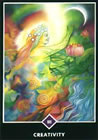
The Osho Zen Tarot is inspired by the work of Osho, a teacher from India (1931-1990). The artist Ma Deva Padma is a meditative artist and disciple of Osho. The goal of this deck is awareness. It is presented as "a transcendental game of Zen ... a wake-up call to tune in to sensitivity, intuition, compassion, receptivity, courage and individuality." The Osho Zen Tarot is divided into the standard major and minor arcanas, but the usual identifiers on each card are absent. The cards are distinguished through the color and numbering/symbol in a small diamond at the bottom of each card. There is also a keyword meaning associated with each card. The court cards are not always pictured as people. They are identified by a direction arrow in the diamond. This deck comes as a boxed set with The Osho-Zen Tarot (176 pages).
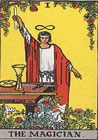
The Rider-Waite Tarot deck is probably the most popular tarot deck in use today in the United States. It was first published in 1910 by Rider & Company, a London publisher. Arthur Edward Waite designed the deck in collaboration with Pamela Colman Smith, an American artist. Waite was a member of the Order of the Golden Dawn, an occult society of the time. Waite considered symbolism of prime importance, so the cards of the Rider-Waite deck were created to communicate esoteric principles through symbols. Waite describes his interpretations in his book The Key to the Tarot, sometimes published with pictures as The Pictorial Key to the Tarot. Waite made several changes from the tarot deck traditions of the time when he designed his deck. He switched the Strength and Justice cards so that Strength became card 8 and Justice card 11. He and Smith also created full pictorial scenes for the minor arcana numbered suit cards. Before this time, these cards usually showed only the suit symbols as in the Tarot of Marseilles. The Rider-Waite tarot deck is the model for many modern tarot decks and also has several variants.